
IEPs and ISPs explained: understanding individualised support plans
What IEPs and ISPs are, what they can include, and the role parents play in shaping support for autistic learners.

Every child learns differently. Yet, our education systems often expect children to learn, communicate and participate in much the same way. Individualised support plans help bridge that gap.
If you are the parent of an autistic child, you have probably spent time explaining that your child doesn't always learn in the same way as their classmates.
Perhaps they need more processing time, communicate differently, struggle with transitions, experience sensory overload or require additional support to participate in everyday classroom activities.
You may have attended meetings with teachers, therapists or school support staff, trying to work out what can be done to make school a more comfortable and meaningful experience for your child.
This is where individualised support plans come in.
You may hear the terms IEP (Individualised Education Plan) or ISP (Individual Support Plan). Although the terminology can differ between schools and education systems, the underlying idea is similar: understanding the individual learner and putting practical support in place to help them access learning in a way that works for them.
For families navigating autism, ADHD, communication differences and other learning challenges, these plans can be an important part of building a more supportive educational environment.
What is an IEP or ISP?
An Individualised Education Plan (IEP) or Individual Support Plan (ISP) is a written plan that identifies a learner's individual needs, strengths and support requirements.
Rather than expecting every child to follow exactly the same approach, an individualised plan considers what a particular learner needs to participate, learn and develop.
It should provide a shared understanding between parents, teachers, therapists and other professionals about:
- What the learner can do and where their strengths lie.
- Which areas require additional support.
- How the learner communicates.
- What adjustments can make learning more accessible.
- Which strategies should be used consistently.
- What goals are being worked towards.
- How progress and support will be reviewed.
An important point to remember is that an individualised plan should not simply be a list of everything a child struggles with.
It should recognise the whole child.
An autistic learner may experience difficulties with spoken communication, for example, but may have excellent visual memory, a strong interest in particular subjects or an ability to recognise patterns that others overlook.
These strengths matter too.
IEP versus ISP: is there a difference?
The terms IEP and ISP are sometimes used interchangeably, although their meaning can depend on the country, education system and school.
Generally:
IEP: Individualised Education Plan
An IEP is commonly associated with a more detailed educational programme. It may include learning objectives, curriculum adaptations, teaching strategies, accommodations and ways of measuring progress.
ISP: Individual Support Plan
An ISP generally focuses on identifying the support a learner needs to overcome barriers to learning and participation. This can include educational, communication, sensory, behavioural and other support requirements.
What about South Africa?
In South Africa, the Department of Basic Education uses the term Individual Support Plan (ISP) within its Policy on Screening, Identification, Assessment and Support (SIAS).
The SIAS policy provides a framework for identifying barriers to learning and determining what support learners need.
The process involves teachers, parents or caregivers, School-Based Support Teams (SBSTs) and, where necessary, District-Based Support Teams (DBSTs).
An ISP is developed as part of the school-level support process and should be reviewed regularly.
While some South African schools and independent education providers may use the term IEP, it is useful for parents to understand that ISP is the terminology used within the national SIAS framework.
The important thing is not necessarily what the document is called, but whether it identifies your child's needs and translates them into meaningful, practical support.
Why are individualised plans important for autistic learners?
Autism is a spectrum, and no two autistic children experience the world in exactly the same way.
One child may communicate verbally but struggle to process spoken instructions. Another may use an AAC device or spelling board to communicate. One may cope well in a structured classroom but find the playground overwhelming.
Some learners may need help with academic tasks, while others require significant support with daily routines, transitions, personal care or emotional regulation.
A standard classroom approach cannot always accommodate these differences.
An individualised plan helps make those differences visible and gives everyone involved a clearer understanding of how to support the learner.
For example, a child who takes longer to process information may benefit from additional response time rather than being repeatedly prompted.
A child with sensory sensitivities may need access to a quieter space.
A non-speaking child may need their communication device available throughout the school day, not just during designated communication sessions.
These are not special favours. They are practical adjustments that can make participation possible.
The importance of processing time
What should an individualised support plan include?
There is no single template that works for every child. The content should reflect the learner's age, abilities, communication style, support requirements and educational environment.
However, there are several important areas worth considering.

1. Communication and language
Communication should be one of the first things discussed.
Not every autistic learner communicates through speech, and spoken language should never be the only measure of understanding or ability.
A support plan could include:
- Whether the learner communicates verbally, non-verbally or using a combination of methods.
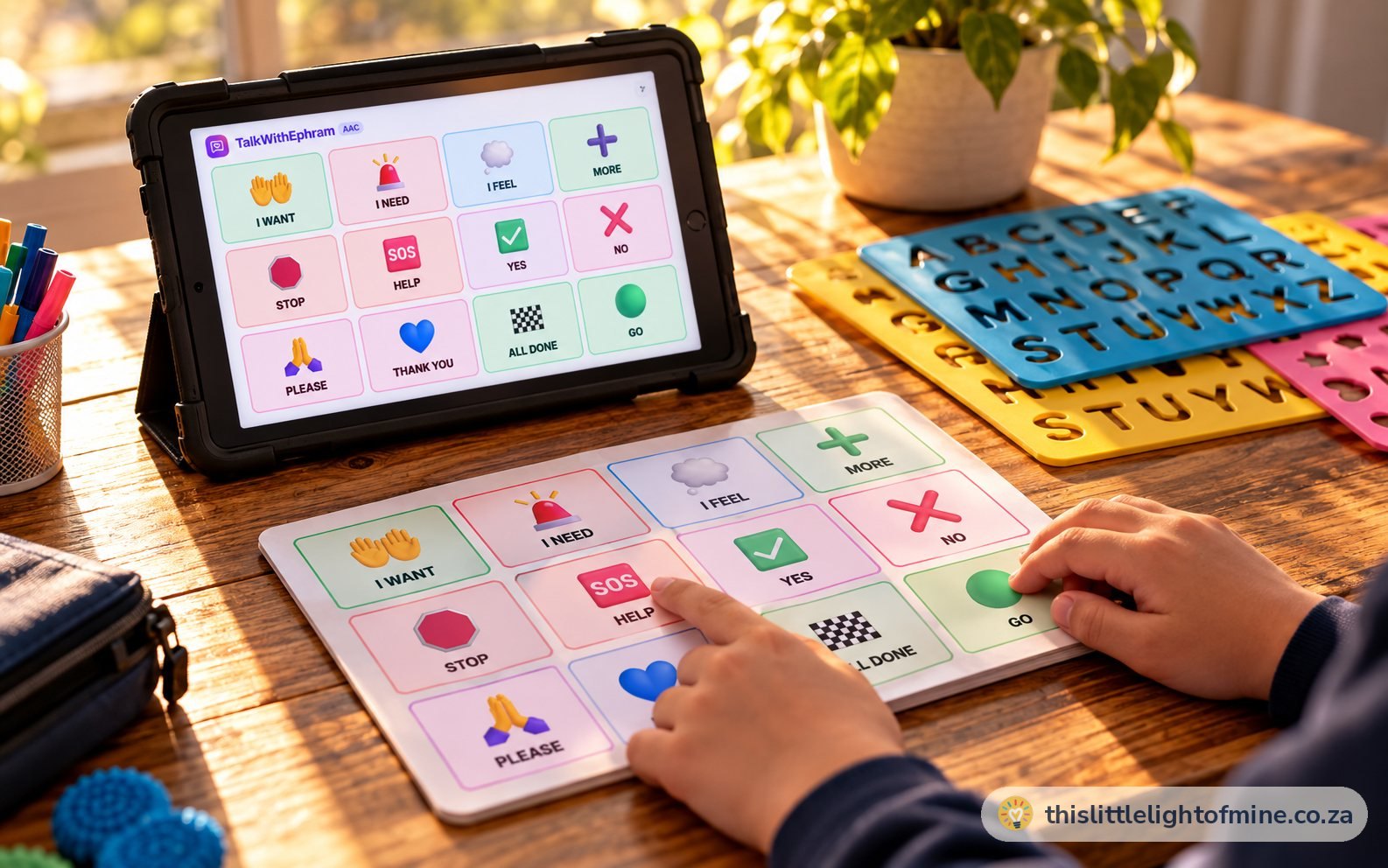
- Access to AAC devices, communication boards or spelling boards.
- Visual schedules and picture supports.
- Additional processing time before expecting a response.
- Strategies for teachers and classmates to communicate effectively.
- How the learner can express discomfort, pain, choices and needs.
For non-speaking learners, access to their established communication methods is particularly important.
An AAC device should be available throughout the day, including during lessons, breaks, social activities and outings.
Communication is not something that should only happen when a child is sitting in front of a therapist.
Understanding life beyond spoken words
2. Sensory needs
Sensory differences can have a significant impact on a child's ability to participate in the classroom.
Some learners are sensitive to noise, bright lights, certain textures, smells or physical contact. Others may seek additional movement or sensory input to help regulate themselves.
A plan could identify:
- Known sensory triggers.
- Access to noise-reducing headphones or ear defenders.
- A quieter space when needed.
- Movement breaks.
- Flexible seating arrangements.
- Adjustments to lighting or classroom noise.
- Strategies for managing busy environments.
Understanding sensory needs can help prevent situations where a child becomes overwhelmed simply because their environment is not suitable for them.
When the world feels too loud: sensory experiences in everyday life
3. Learning and curriculum adaptations
Not every learner can access the curriculum in the same way.
Some children may understand a concept but struggle to demonstrate their knowledge through written work or traditional assessments.
Others may need concepts broken down into smaller steps, additional repetition or visual explanations.
Possible adaptations include:
- Shorter, more manageable tasks.
- Visual instructions and demonstrations.
- Additional time to complete activities.
- Alternative ways of demonstrating understanding.
- Reduced distractions.
- Adapted learning materials.
- A different pace of instruction.
It is important to distinguish between making learning accessible and lowering expectations unnecessarily.
A child should not be denied opportunities simply because they need a different way to access the material.
4. Emotional regulation and wellbeing
Emotional regulation can be particularly challenging for autistic learners.
Changes in routine, unexpected demands, sensory overload and communication difficulties can all contribute to distress.
A support plan should identify what helps the learner feel safe and regulated.
This could include:
- Predictable routines.
- Advance warning of changes.
- Visual timetables.
- Access to a calm space.
- Recognising early signs of distress.
- Allowing time to recover after overwhelming experiences.
- Understanding that behaviour may be a form of communication.
The aim should not be to make a child appear more compliant or to suppress harmless autistic behaviours.
It should be to understand what the child is communicating and provide the support they need.
5. Social participation
Social interaction does not look the same for every child.
Some autistic learners enjoy being around others but find unstructured social situations difficult. Others prefer smaller groups or parallel activities.
Support could include:
- Structured opportunities for interaction.
- Support during breaks and group activities.
- Respecting the learner's need for personal space.
- Encouraging friendships without forcing interaction.
- Helping classmates understand different communication styles.
- Providing alternatives when group activities become overwhelming.
Being included should mean having opportunities to participate in ways that feel comfortable and meaningful.
6. Daily living and independence skills
For some learners, particularly those requiring more substantial support, educational goals extend beyond traditional academic subjects.
Everyday skills can be equally important.
These may include:
- Personal care and hygiene.
- Eating and drinking independently.
- Following daily routines.
- Making choices.
- Communicating needs.
- Recognising familiar people and places.
- Developing practical life skills.
- Participating in household or community activities.
For older learners, these skills can become an important part of preparing for adulthood.
Progress does not always have to look like achieving another academic milestone.
Sometimes learning to communicate a preference, complete a daily task or participate in a familiar activity is an enormous achievement.
Who should be involved in developing the plan?
An individualised support plan should never be something that is created in isolation and simply handed to parents to sign.
It should be a collaborative process.
Depending on the learner's needs, the people involved may include:
Parents and caregivers
You know your child beyond the classroom. You understand their routines, communication, interests, sensitivities and what helps them feel safe.
Your observations and experiences are valuable.
Teachers
Teachers play an important role in identifying learning barriers and implementing practical classroom strategies.
School-Based Support Team (SBST)
In South Africa, the SBST coordinates support at school level and helps identify strategies to address barriers to learning.
District-Based Support Team (DBST)
Where additional support is required beyond what the school can provide, the DBST can become involved in assessing needs and coordinating further support.
Therapists and other professionals
Depending on the learner, input from occupational therapists, speech-language therapists, psychologists and other professionals can help inform the support strategies.
Most importantly, where possible, the learner should also be involved in decisions about their own support.
Their preferences, comfort and experiences should matter.
What if your child's school does not have an individualised plan?
If your child is struggling at school and you feel their needs are not being adequately addressed, you can start by requesting a meeting with their teacher.
Explain your concerns and provide practical examples of situations where your child experiences difficulties.
In the South African public education system, the SIAS process provides a framework for identifying and addressing barriers to learning.
Parents and caregivers are an important part of this process.
If the school requires additional assistance, the matter can be referred through the appropriate support structures.
It is also helpful to keep written records of meetings, recommendations and agreed actions.
If you are unsure about the process, you can request guidance from your provincial Department of Education.
An individualised plan should grow with your child
One of the biggest mistakes we can make is treating a support plan as a once-off exercise.
Children develop. Their needs change. Strategies that worked last year may no longer be appropriate.
A learner who previously needed substantial support with communication may develop new ways of expressing themselves. A child who coped well with a particular classroom environment may struggle as academic and social demands increase.
For teenagers, the conversation should gradually include preparation for adulthood.
This may involve:
- Developing practical life skills.
- Exploring vocational interests.
- Building independence where possible.
- Identifying appropriate communication and support systems.
- Preparing for transitions between schools or educational programmes.
- Considering what meaningful participation in adult life might look like.
The plan should be reviewed regularly, with adjustments made when necessary.
It should reflect the child who is in front of us today, not simply the child they were when the document was first written.
Growing up with autism: looking towards the future
A little reminder for parents
Navigating the education system can be exhausting.
There are forms to complete, meetings to attend, assessments to arrange and conversations that sometimes feel as though you have to explain your child all over again.
It can be particularly difficult when you feel that you are constantly advocating for things that should already be understood.
But remember this: your child is more than a diagnosis, a school report or a list of support requirements.
An individualised support plan is not about defining everything a child cannot do.
It is about recognising what they need to succeed, participate, communicate and experience a sense of belonging.
It is about helping the people around them understand that there is more than one way to learn, more than one way to communicate and more than one way to make progress.
And perhaps most importantly, it is about making sure that your child's education is built around the individual they are, rather than expecting them to fit into a system that was never designed with their needs in mind.
Every child deserves to be seen, understood and given the opportunity to shine.
Share this story

We are the family behind This Little Light Of Mine, sharing our journey with profound autism to shine a light on autism and open doors to understanding.
A note about this article
This article shares our family's lived experience and general information. It is not a substitute for individual medical, developmental, educational, or professional advice.
More stories
Keep reading
Why communication cannot always be measured through speech, and why patience and individualised communication support matter.

How allowing time for a response can change the way we communicate and interact with autistic people.

Sounds, lights, crowds and unfamiliar places can affect how our son experiences the world. We share what we have learned about noticing and respecting sensory needs.
Follow our journey
On Facebook and Instagram we share more of the everyday moments, experiences, challenges and milestones that make up our family's journey.